
Skipper Chong Warson
15 June 2021 · 1 hr 8 mins
About this Episode
Recorded in their child's bedroom on a weekday, Laura and Skipper chat about his academic background in writing (English literature, playwriting) as well as his professional background as a product design director (think desktop and mobile apps among other mediums) and how that plays into storytelling, most recently resulting in the creation of How This Works, this podcast.
They also talk about their life together — newsflash: they're married and living in the San Francisco Bay area, having moved from New York City a couple of years ago. Along the way, they get into some of the differences between life in SF and NYC. They also talk about their upcoming wedding anniversary after getting married next to Jane's Carousel in Brooklyn Bridge Park.
Along with talk about his name change from Starr to Skipper (and not Optimus Prime) at the age of seven, they bring in a few questions posed from the listening audience including lessons learned from the first season of the show, calling people the name they want to be called, how crucial listening is in making a podcast, the ubiquity of imposter syndrome, using the five (5) whys to get to the root cause of a challenge as developed by Sakichi Toyoda at the Toyota Motor Corporation, team falling asleep during movies versus team staying awake during movies, and why Skipper color codes versus alphabetizing the books in his background — see photo below.
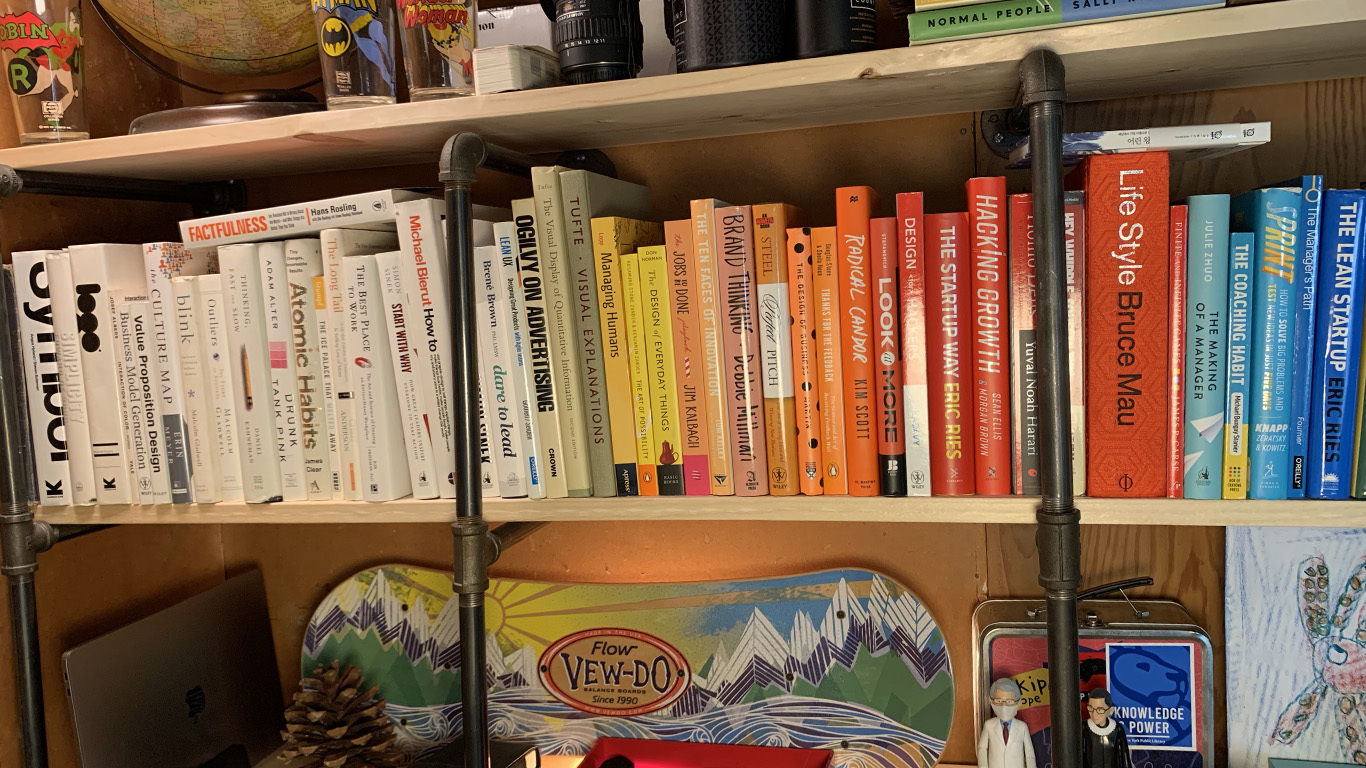
View of the three shelves behind Skipper's standing desk
Laura and Skipper also reference the following previous episodes, in order of being published, including:
- Jack Kahana, the first episode
- Dr. Peter Chin-Hong, the third episode
- Selena Rosanbalm, the sixth episode
- Cassandra Carlopio, the 15th episode
- Kat Hantas and Nicole Emanuel from 21Seeds, the 17th episode
- Sally McRae, the 18th episode
- Piper Payne, the 20th episode
Stay tuned after the outro music for a bit of tape where Skipper pauses for a bit of background noise and how from where Laura's sitting, the microphone makes it looks like his nose is a black bit of foam.
Transcript
[Intro music] Laura Clifton: Hi, my name is Skipper Chong Warson and I'm a design director in San Francisco and you're listening to How This Works -- actually, that's not true. My name is Laura, please join me this week on How This Works as we flip the script and I interview Skipper Chong Warson, your venerable host of How This Works. Skipper Chong Warson: (Laughs)
Laura
Hi, Skipper, thank you for making the space and time to join me today.
Skipper
You're welcome. Thank you for carving out the time yourself.
Laura
Let's start with pronouns, mine are she and her. How do you like to be referred?
Skipper
I prefer he and him, please.
Read Full Transcript Hide Full Transcript
Laura
So Skipper Chong Warson, who are you? Tell us a few things about yourself.
Skipper
Well, I suppose we can start with what's normally read as part of the show intro -- I am a design director in my work life, my full-time work life. And I do live in the San Francisco Bay Area.
Laura
Okay.
Skipper
We moved here about a year and a half ago, almost two years ago now -- having lived in New York City for a decade.
Laura
Do you miss New York?
Skipper
Do I miss New York? I miss the idea of New York City. When anyone has ever asked about NYC, when we lived there, I would often say to them that everything that they've heard is 100% true and 100% false. Because there are so many different nuances to one's experience of living in the most populated city in the United States. And it's also relative to where you are and what you do. So what might be happening in downtown Manhattan, it's going to be very different from where we lived on the Upper West Side and/or in Upper Manhattan versus what was happening in Brooklyn --
Laura
Or Queens.
Skipper
Right. Or Queens or the Bronx.
Laura
Yeah, sure.
Skipper
So I definitely miss the idea of it. I know our child misses it. Because having moved from New York just before the pandemic, the summer before the pandemic, they often say that they want to go back to New York, right? That in their mind, New York was this perfect place where they were born, they were raised for the first few years of their life. Then, we left and seemingly the world fell apart, right?
Laura
And then they moved to California and everything fell apart. I miss New York, I miss -- it's funny, I've become a lot more, I don't feel like I've had the for the last year and a half, I don't feel like I've had the luxury to think about anything other than what is happening right in front of me. So, in this past week, I've really been recalling our time in New York and I really miss it. I miss -- there a lot of things that I miss about living there. And there are a lot of things that I'm grateful for. Yeah, so I feel you on that --
Skipper
What's one thing that you miss about New York just to pull something out?
Laura
I miss the walking culture.
Skipper
Yeah.
Laura
I miss my body being my transportation that I get either walk or jump on a train or bus so easily and seamlessly. And as we lived there, New York had become sort of become the largest, the most populous that had ever been so --
Skipper
It definitely swelled in people numbers.
Laura
It did. And so, you know, the trains were delayed, sometimes everything everyone complains about the trains --
Skipper
Sometimes?
Laura
(Laughs)
Skipper
The train would pull into the station and you see the crowded car, people would step out just to let other people have room to step off.
Laura
Yeah.
Skipper
And you think or I would think sometimes do I really want to cram myself into that tin of sardines?
Laura
And then when you wait for the second train, and it's crammed, and by the time the third train comes in, it's still crammed, you're like, All right, well, I'm getting on.
Skipper
I have to get on it.
Laura
I have to get on it, or I'm going to walk 40 blocks, that's fine. I'm also sometimes in the mood to walk 40 blocks, so it's fine.
Skipper
Right.
Laura
Yeah, I miss that. I miss the walkability of that. I really miss the Natural History Museum because I spent so much time there with our child.
Skipper
Yeah.
Laura
I really miss it. And I miss the availability of -- because I know that someone from the Bay Area would say if I say I miss the availability of the culture that we had, well the Bay Area has a lot of culture and it does. The museums, the ballet, the opera, we took advantage of a lot of underground theater and dance --
Skipper
The theater scene and the musical theater scene, yeah.
Laura
And dance, we have lots of friends who are in dance and the things that we saw and did and that we ourselves performed in public parks in New York. I miss a lot of that. Would I pack up and move back there right this moment, I don't know that I would pack up and move anywhere right now because the idea of packing up, I just need to get through lunch today. But yeah.
Skipper
All right.
Laura
So you moved here a year and a half ago? We did -- I guess I was with you, I don't know how that happened. That was cool.
Skipper
Yeah.
Laura
We took a drive across the country.
Skipper
We drove across the country, saw some parts of the country that we'd never seen before. And my background, just to say one more thing about who I am -- my college degree is not in design. That's not what I studied in school.
Laura
What did you study in school?
Skipper
I have a double major -- one's in English literature and one's in playwriting. And what was interesting is that, while I studied writing, I attempted to do the least amount of writing possible. In that I mean, I did all my coursework, I turned in all the things I was meant to do but I didn't want to do any extra work in writing, I wanted to write as little as possible.
Laura
Then, why did you get a degree in ...
Skipper
Hold on, hold on. For my work studies and the other occupational things that I did during the time that I was at university, I actually did design work. So by the time I graduated, I had as strong a writing portfolio as I did a design portfolio. And I didn't want that to be the only muscle that I was flexing. So the way that I often give the example is that I believe that design and writing are both about storytelling. One is about writing the story, constructing the story from words but then design is another way to tell the story, albeit more visually focused, the way that things are laid out -- the flow of text blocks from here to there, even in our more modern business context, how you might present something to a client or internal stakeholder or someone on your team, how do you "sell them" or tell them a compelling story around an idea?
Laura
I have a flood of questions happening in my head right now. Let me see if I can -- So do you feel, have you sort of always been in a creative mode? Obviously, your degree is creative. What you do now is creative.
Skipper
Right.
Laura
It's really hard to ask this question because I know for myself, for anyone listening, it's very difficult to think back to when you're 18. And what you imagined -- because this is not I'm sure for either one of us what we imagined, this is beautiful, I'm happy to be here with you. Let me say that. However, this is not what this is not the trajectory that I saw myself going.
Skipper
If you would have asked me at 17, 18 where I thought I was going to be it probably doesn't match up to where I am today. And that's not a complaint. That's more of a compliment of how life throws a series of twists and turns and as a human being in the world, you adjust and you change.
Laura
My larger question is did you always know that you had a creative spirit inside of you and that you wanted to follow something that felt more artistic? So storytelling, you can do it visually, you can do it with the written word, so you wanted to -- did you feel compelled, you could do it in in all kinds of media and filmmaking, etc. So did you know in your heart that you wanted to follow a creative path?
Skipper
I think so. Growing up, I was a voracious reader. But I didn't do much in the way of extracurricular writing until probably middle school or high school. I don't know that I was super artistic in the way that some people talk about drawing all the time or painting all the time, or whatever that medium is for them. I do remember in a seventh-grade art class that we were doing figure drawing -- and I thought, oh, and you know, it was very typical, there was a sphere, there was a pyramid, and then a rectangle. And you're supposed to draw the shapes and then also shade them. And I remember that first class struggling to accurately capture what I was seeing in the scene in front of me. And the next day, I brought to school a compass and a ruler to make the straight lines.
Laura
(Laughs.)
Skipper
And immediately, my art teacher said, No, that's not how. You have to just draw it the way that you see it. And I said, But they're not straight. They don't the way that I'm drawing it and I showed her my previous attempts, the way that I'm drawing. It doesn't look like that. And she said, Well, you have to keep working at it. It's not about using a perfect circle shape or using a straight line. And I think that was a lesson for me in you can't do the thing perfectly no matter what the tool is that you have, that it's always going to require work and iteration and cycles.
Laura
That's the beauty of that though if you take out the iterative process, then you lose so much of the joy of that creation, whether it's a photo or a painting or a play, or then you lose that when you if you try to just perfect every step of the way, that's not interesting. Yeah, that's not compelling.
Skipper
Although there are moments that have been documented around, someone going in, like Black Sabbath when they went in to record their first album, allegedly, they came in and recorded everything on the first take. Just straight through. And I think what I heard is that it was all done in one day. And that doesn't take into account the fact that the members of Black Sabbath already knew how to play their instruments, there was a lot of pre-work that happened before they ever walked in the studio --
Laura
They played together and creatively collaborated many times.
Skipper
That's right.
Laura
So that's still an iterative process.
Skipper
Exactly. And while they did have a magical moment in creating the tracks for their debut album, even that seems so stupendous and amazing -- the fact that they were able to walk in and do it all in one take in one day, and just have this thing that sometimes takes bands or a single person days, if not weeks, if not years to create.
Laura
So you're a design director. You live in the Bay Area. What else do you do? What else would we know about you? You're the host of How This Works.
Skipper
I am the host of How This Works.
Laura
Welcome.
Skipper
What a lovely podcast this is, thank you.
Laura
Yes, welcome. There's also a Barbie house there if you want to play with it.
Skipper
Oh, yes. We're not including a visual, but we are recording in our child's room so we are surrounded by a tiny bed and all sorts of toys.
Laura
Lots of stuffies.
Skipper
Lots of --
Laura
If you get nervous while I'm asking these questions, grab your favorite stuffy and feel the comfort. There's a cheetah close to you. So --
Skipper
Cheetah, I see Cosy Rosie's next to you.
Laura
Yeah, there's a sloth, a giant tiger, multiple choices.
Skipper
So last year, I thought to start a podcast. And it's not as though I didn't have --
Laura
Along with many other people who had a lot more time in their home space.
Skipper
Sure.
Laura
Yeah.
Skipper
And many other pandemic projects. And it's not as though I'd never created a podcast before -- now to do the marketing piece and the planning piece and to be very regular about it, that was something that was new to me. At a previous employer, I had created an internal podcast, and then I helped work on their flagship podcast. So I did have experience in recording, scripting questions, even some of the producing side -- editing, etc. But I have to say that making a podcast that is a thing that exists out in public, that becomes something that some amount of people will know you for, it's nerve-wracking in a way. And one of the things that you know about me as my wife is that I can be very literal --
Laura
Newsflash, I am Skipper's wife.
Skipper
For those people who didn't know -- is that I can be very literal about things. So in sketching out the initial version of this podcast, I thought, Oh, we'll set a goal for it. We'll talk to 100 people about things that they know. And I know that's generally a podcast formula. It's not a novel approach to a podcast. But I did want to box it for myself. So that way, you know, I had something that I was aiming for, but yet gave me enough flexibility to find out about people and subject matters that I didn't necessarily know about.
Laura
What --
Skipper
I also --
Laura
Oh, go ahead.
Skipper
I also had indicated that it was going to be weekly. So that's one thing that I've struggled with because there will be weeks where things fall off -- guests don't get scheduled expediently, schedules fall apart, all sorts of things happen and some weeks, there isn't an episode, a new episode that's available. So that's one thing that I've struggled with is delivering on the promise that I've made in creating this podcast, but then also being easy on myself as a creator, producer, etc.
Laura
Because you are very literal, you do want to deliver weekly.
Skipper
That's true. That's what I said.
Laura
Being literal, when he uses the word literal it is an understatement. WYSIWYG -- what you see is what you get. So, what is, what's something, so far, in the short tenure of this podcast what is a valuable lesson that you've learned in speaking to all the people that you've spoken to thus far?
Skipper
I think one of the things that I have come to realize is that, for the most part, people don't truly grok what it is that they know until they are sharing it with someone else. So this is something, this is something that I uncovered. When I created the internal podcast, when I worked at Fjord, it was called Design Voices. But what I was interested in is finding out more from my peers, the junior designers, even some other folks who weren't necessarily as loud as some of the senior or leadership folks within the office. So it was about talking to other designers in other disciplines. So not just the visual designers, but also the interactive designers, or the business designers, or research folks, just getting a sense of who they were, and what are the things that they knew about, right? So it was meant to be shining a light on maybe some of those people you didn't hear from normally. and nine times out of 10, when I would approach someone, even if they had worked in a discipline, user research or prototyping or --
Laura
Biz dev.
Skipper
Business development, data and design. They would always say to me, I don't know why you want to talk to me about this. I don't know enough about it. So I feel like people are perpetually cutting themselves short, to say, well, and being humble, I think is a great trait but I think too many times people underestimate the amount of information that they know, or that might come out in a conversation saying more about, Oh, can you tell me more about that, and really drawing out those things that people know, but they don't think they know.
Laura
Imposter syndrome is ubiquitous in that way.
Skipper
Yeah.
Laura
Even when someone is considered an expert in their field, most of the time, they still feel like, Oh, I have so much more to learn.
Skipper
Right.
Laura
Because once you start navigating that you realize how much you don't know, even in your own field, even in your own expertise.
Skipper
Right.
Laura
That's a really nice way to frame that. I am also curious, is there Have there been any surprises in either something you've heard or have conversations? And as they do, as you just mentioned, conversations ebb and flow and, and once someone starts opening up and speaking, it might take a direction that you don't expect. Do you find that that happens fairly often?
Skipper
I think in every episode, something like that has happened. And one lesson that I am continuously learning as a result of making the podcast and putting it out in the world -- and being the person on the other side of the microphone -- is that more important than researching that person or subject matter. More important than having the right gear, listening is the most important piece of it.
Laura
Are you a good listener?
Skipper
(Laughs) I'm an excellent listener. Absolutely excellent. That's why when I listened back on all of the episodes, there's nothing ever missing.
Laura
Mm-hm.
Skipper
You know, and listening back to some of the episodes I have never said once. I can't believe I didn't ask this question.
Laura
Mm-hm.
Skipper
(Laughs) I think that I have, I'm a listener with very good intentions. I'm sometimes distracted and I am not the best listener. But I am committed to being better.
Laura
Committed to change.
Skipper
That's right.
Laura
Change for the better. Skipper Chong Warson Incremental improvement, that's all we can hope for. Laura What is something -- this is something that you often ask at the beginning of your show, what is something that many people might not guess or know about you, something obviously that you feel comfortable sharing? As a side note, like there's something I just learned about you the other day, which is often wonderful to think you could spend X amount of years with someone still not ever know everything about that person. It's the beauty of relationships.
Skipper
What did you learn the other day?
Laura
I don't remember.
Skipper
(Laughs)
Laura
I just remember thinking, Oh, I didn't know that about you.
Skipper
Touché.
Laura
I don't remember what it was. There was also something my mum said the other day and I thought, Ah, I didn't know that about you. I mean, it's great to learn. So what is something that you feel comfortable sharing that most people might not know about you?
Skipper
Sure. So I think one of the things that comes to mind the quickest is around my name. I say it at the top of every show, my name is Skipper Chong Warson. And that is true but has only been true since I was seven. Before that, that was not my name. And when I was seven, I sat down and I made a list of all the names that I could have. The list came down to Skipper or Daniel. And the reason why I picked Skipper over Daniel, and there's nothing wrong with the name Daniel -- my grandfather's name was Daniel, one of my very best friends in the world's name is Daniel. But the reason I picked Skipper is because when I was born, I was named after my father, and my great grandfather, their first names were Starr, S-T-A-R-R. And after growing up with a name like Starr, I didn't feel like I could be a Dan or Danny or Daniel. And so Skipper it was.
Laura
And why was your name changed?
Skipper
So when my father remarried, my stepmother wanted to legally adopt me, even though she was under no obligation to do that. And part of legally adopting me, she had asked me as I recall if I liked my name -- and I've heard this analogy from many people, but the idea of changing your name at seven, that maybe I should be glad that I didn't pick Barry Allen or Optimus Prime.
Laura
Optimus Prime is a fantastic name.
Skipper
Optimus Prime would be a cool name.
Laura
And there are some cultures actually that roughly around that age like a child comes into their own and they sort of choose their own name -- you didn't grow up in a culture where that was part of that?
Skipper
No, but there is an element of Korean culture in America where if you introduce yourself and you visually look more Korean than not, I suppose, often the question put to you is, Well, that's your American name?
Laura
Right. What is your Korean name?
Skipper
Yeah, what is your Korean name? And that often is given to children who are first-generation so that they might assimilate "more into" American life.
Laura
So at this point now, you have been legally Skipper for a fairly long time? Do you remember it being difficult when your name was changed to grow into that identity? Or to get used to people calling you by the name Skipper? Do you have a memory of that at all?
Skipper
I don't really have a memory of that. My grandma Blanche, she sometimes would call me Starr still, there are some members of my mother's family who call me Starr because that's how they remember me.
Laura
Your birth mother's family.
Skipper
My birth mother's family. And I have a dim memory of a teacher in the third grade. So right after the name change happened, I think Mrs. Anderson had a copy of my old school records and they still have Starr on them. So those would be the only people that I really remember still calling me Starr. So much so that I think of Starr only as my father's name.
Laura
So when you hear the name Starr now, there's, unless you're speaking to someone who, who calls you by the name there's very little resonance within you.
Skipper
That doesn't sound like my name.
Laura
Skipper sounds like your name.
Skipper
Skipper sounds like my name.
Laura
It's a name you don't forget easily.
Skipper
Yeah, I've only met one other person who, and in fact, they weren't the person they knew someone whose real name was Skipper, but I've never met one on one another person whose name was Skipper. I didn't plan it that way. Right? I didn't count on picking a unique name. I just thought Skipper sounded more in line with Starr than Daniel did. As much as maybe one of the arguments when I was seven for changing my name from Starr was to get away from some of the teasing that happened in school on playgrounds, things like I remember there being a star bar and with a name like Star Warson and I got a ton of Star Wars jokes. But then --
Laura
Star Wars is cool.
Skipper
Star Wars is cool, but it's doesn't matter how cool it is if you're being made fun of for it.
Laura
And no one made fun of Skipper?
Skipper
Well, I didn't think that through fully, you know, brand name peanut butter, Barbie's sister. I think there's a dog food named Skippy, Skipper, something.
Laura
The peanut butter is Skippy.
Skipper
I do not answer to Skippy. Laura No, no, no. I won't -- Skipper Chong Warson I, generally speaking, don't answer to Skip.
Laura
Yes, there are some legacy people in your life -- your sisters being two of them and your little brothers I suppose that call you Skip and they're allowed to, they're family. We have two friends that call you Skip, they're legacy friends. However, for people that call you Skip -- Skip is a blonde 1950s dude who's diving into the water... I thought, my husband is not Skip, please don't ever call him Skip.
Skipper
Although I do remember one of these friends, our mutual friend that we both have, a dear friend, Jim. And I remember when the notion of my coming to a party he was having, I heard that he said, Yeah, sure. You can invite this guy Skip, but I'm not really into meeting a guy named Skip.
Laura
I don't need to know a dude named Skipper.
Skipper
That's right.
Laura
This is the man that married us.
Skipper
That's right.
Laura
So you feel so, Skipper feels like you don't have an identity crisis -- you feel like Skipper?
Skipper
Yeah, I think so. I think that's a fair statement.
Laura
And it's funny in listening to you and thinking about Skip and Skipper -- do you have a thing about that where -- I've heard you introduce yourself and people might say, So, Skip. And you're like, Oh, no, it's Skipper. And you have a very generous spirit with that. Do you prefer to call people by their full names? Or do you have people that you use shortened versions of their name? Like, do you have a feeling about shortening someone's name and making it like a cute nickname or --
Skipper
So it's one of the things that I do on the show. And I specifically ask people what they want to be called. And I practice saying their name with them. Sometimes, it'll end up as one of the outtakes at the end of the show. But I think that's something that's really important about understanding what they want to be called, versus what is their printed name, what is the name that they go by professionally. So I think there are a few different layers. And I think it's about using the name that that person feels most comfortable with. And it doesn't matter if it's recognized in the world, if it's not a legal name. I don't think any of that matters. I do think it's important to and especially as we live in a global culture, to make sure that you are saying people's names right.
Laura
Yeah, I think that -- you don't obviously, but there are people though when they when you first meet them, they as soon as they hear your name make a nickname out of it, not just you Skipper, however, anyone in general.
Skipper
Pick anyone. Yeah, someone introduces themselves as James, they --
Laura
Hey, Jimmy.
Skipper
They'll become Jimmy. Exactly, exactly.
Laura
Yeah. I had an uncle. My name is Laura. I have never identified with the name Laura. It does not fit me in any way shape or form. It's a fine name. There's nothing wrong with it. I just don't identify with it.
Skipper
We're going to get angry letters from other Laura's.
Laura
Yeah, it's beautiful. And it just doesn't ever feel like me. It doesn't feel like who I am inside me. And I had an uncle who called me Laurie, which felt even worse than Laura. I'm definitely not Laurie. If I'm not Laura, I'm certainly not Laurie, call me something else. So it's, I like that you feel like that you sort of own your name, as long as I've known you that you sort of own that piece of you. So I want to jump back into the idea of creating this podcast which is a version of storytelling for you. You're helping to tell other people's stories. What is one thing that you really hope to accomplish by putting this out in the world? What is something that you would feel really positive about as a result of creating this?
Skipper
That's a really good question. This is one of those things where I believe that in your life, you should approach things with some intentionality and have larger goals around them. For me, I think this podcast is about iteration. And it's about working on making each episode, each interaction with a guest better than it was before, right, getting better -- understanding all of the nuance, the moving parts about being a better listener. I will often circle back with someone that I've talked to on the show, and I will send them a note asking, Do you have an idea around maybe one or two other people I could talk to on the podcast. As of right now, I have a very loose list of subject matters that I want to learn more about. And that might become more articulated over time, maybe midway through the second season or maybe in the third season. But the thing that I ask previous guests of the show is if they know someone who would be a good candidate to be on How This Works and understanding that I'm not necessarily looking for people in this, this, and this subject matter.
For instance, one of the things that I'd like to learn more about is around solar panels and solar arrays and how solar energy works, both in terms of how panels are manufactured, how they're optimized, all of those things. That's one example, one subject matter that I'm interested in learning more about, but it's more about people who know certain things in the world. And after you talk to them about this thing that they know about, your response is something like, Hmm, that's interesting. I didn't know that. Or, I'd like to learn more about that.
Laura
Right.
Skipper
It's that twinge of interest that happens when you talk to someone who knows something very deeply and/or positions it in a way that you'd never considered it before.
Laura
So you sort of answered both questions -- I mean, you answered the question in two ways. One, what you personally are hoping to accomplish and what you would want a listener to receive from this podcast, you want a listener to be able to learn something new or to become interested to follow a line of curiosity.
Skipper
For sure.
Laura
And to maybe even look at the world and the people around them with new eyes. Everyone has a story, everyone is an onion.
Skipper
Everyone has a story.
Laura
Everyone is compelling in some way. Whether it's a good compelling or not so good compelling, sure. So when you think about this, when you think about guests that you bring on, is there other than asking previous guests, if they have someone they'd recommend, how else do you go about finding guests for the show?
Skipper
So I think for me, it's also about keeping my eyes and ears open in the world. My wife, Laura is also good at suggesting guests to me.
Laura
Is she?
Skipper
She is.
Laura
Aw.
Skipper
She's a really nice person, you should hang out with her.
Laura
(Laughs.)
Skipper
She, and then I think I can include myself in this number, so I'll say we, in addition to other people, friends, family, previous guests, often people will circle back to me and say, Hey, have you read this thing in the same way that you share an article that you read. And sometimes what happens is that when I read that article, I might dig into one person who's quoted or the person who wrote that article. I think it comes from a variety of different sources. As of right now, the subject matters and the guests on the show are as a result of natural curiosity.
Laura
Okay.
Skipper
I do believe that you know, if each season of the show is 20 episodes or so, and this stretches into five seasons, then I think that there will be moments where some of those things will be more intentional than others. And not the sort of accidental bumping into this subject matter and by proxy, this person who knows the subject matter.
Laura
So some of your guests, though, so far, and I know this, you've cold called essentially.
Skipper
That's right.
Laura
You read an article, someone told you about them, and you just reached out and you're like, Hey, I think you would be interesting to speak to, I'd like to hear more about you and how you speak on the subject matter and you've received you've actually received some positive response for that. So that's pretty cool.
Skipper
Yeah, and there's a ratio, right? Of you go up for bat and you ask someone a question. I've yet to get any interest from any politicians that I've reached out to.
Laura
They're busy.
Skipper
They're busy, there's a lot of stuff going on. But Dr. Peter Chin-Hong, you know, he was the third episode, where we talked about the novel coronavirus and COVID-19.
Laura
PCH.
Skipper
PCH. He responded to an email that I sent to his UCSF email. Similar for Cassandra Carlopio, she's working on how we can sleep better and leveraging meditation to that end. Sally McRae, the runner, endurance runner, professional endurance runner. Piper Payne, right, her subject matter came out of an episode that I did with a friend of mine, Selena Rosanbalm, and we were talking about the process of recording Selena's album. And she talked about recording it, mixing it, and mastering it. And she articulated a little bit around mixing but then when I asked her the question, Well, what does a mastering engineer do? She said, I honestly have no idea. And she's recorded multiple things in her life -- two full-length albums, among other things. And so then I went looking for a mastering engineer and Piper very graciously said she would talk to me.
Laura
And that is one of my favorite episodes.
Skipper
That's a great episode. We're already planning a part two. Laura Yeah, Piper Payne is amazing. What an amazing guest. Yeah.
Laura
As all your guests I've enjoyed. Skipper Chong Warson Yeah. Laura Is there a way that you -- and is there, aside from solar panels? Are there any subjects that are peaking for you right now just in case your listeners might have someone that they could recommend that you speak to? Or aside from solar panels? Are there any other -- I know you've reached out to a few politicians and I mean, this is a busy year for politicians.
Skipper
It is a busy year. And you know, I don't know that a politician would want to go on record with a small-ish/medium to small-ish podcast. So some of the other topics, I have a running list. For instance, how coffee is made, you know, the process of roasting and harvesting and the idea of single-origin versus mixing blends, or, you know, the economics of coffee farming.
Laura
Sure.
Skipper
Similar for chocolate, I think there's a lot of ambiguity around how those two substances are produced.
Laura
Like the sisters from 21Seeds. That was an incredibly informative show about the process of tequila infusion and making tequila, how, and how similar to champagne that tequila is from a very specific region. Otherwise, it's not tequila.
Skipper
I had no idea.
Laura
Yeah. Let's do a shot. Happy early anniversary, by the way, our anniversary is in two days?
Skipper
Our anniversary is in two days, that's right.
Laura
Two days, I'm sorry, I just wasn't sure what today was, I knew that was close. I'm really tired.
Skipper
How many years?
Laura
You're holding up fingers. Seven, nine? We've been married nine years?
Skipper
We've been married nine years.
Laura
Wow. That's pretty cool.
Skipper
Mm-hm.
Laura
That's very cool. We got married in Brooklyn Bridge Park in between the Manhattan and the Brooklyn Bridge, it's very pretty -- in front of Jane's Carousel for anyone who has ever lived in New York or traveled. It is a beautiful park and Jane's Carousel is a must-see. If you want to see some stunning photos of Jane's Carousel, you should look up when Hurricane Sandy hit because the water came right up to the carousel and it looked like it was floating in the East River.
Skipper
Yes.
Laura
It was remarkable, remarkable that it's still standing.
Skipper
That was 2012. No, was it before or after we were married?
Laura
It was after.
Skipper
After. Okay, so like 2013 or 2014?
Laura
Yeah.
Skipper
Okay.
Laura
I'm pretty sure. Yeah. We should look that up.
Skipper
We should probably fact-check that
Laura
We should probably fact-check that.
Skipper
But I think the process of trying to remember something, I think can be more interesting. So yeah, we'll say after we were married.
Laura
It was after we were married.
Skipper
In 2012.
Laura
We were married in 2012. That's why it's nine years because it's 2021 -- I mean, 2020 is sort of a lost year, so we can just celebrate eight again.
Skipper
We can celebrate eight. Yeah.
Laura
So back to How This Works and your storytelling abilities. Do you ever think, um --
Skipper
I don't think my abilities are that stupendous but I do think they are getting better. I am committed to continuous improvement.
Laura
You are a very good host. You're very enjoyable to listen to.
Skipper
That's really all I was hoping for in recording this episode, so --
Laura
So that I would compliment you.
Skipper
That's right.
Laura
Did you need a little ego pump today?
Skipper
That's right.
Laura
I got you, babe. Don't worry. I like listening to you. I think you're a very good host of this podcast. One thing I was curious about -- do you ever plan on expanding and occasionally having a guest host with you? Or is that something in your future?
Skipper
I'm definitely not opposed to that. It would have to be someone who -- I'm not opposed to that.
Laura
I want to know more... So something that I'm going to divulge to your listeners, may not be that interesting. It's making me think of an article I read earlier today when we moved to the Bay Area -- and we had an idea, we had a timeline here. However, like everything that happened from everything that's happened in the last year I think everyone's timeline to what they were headed to before has shifted and changed drastically. Is there anything else that has in your timeline, in your own personal storytelling that has shifted and changed for you?
Skipper
Was there anything in my own personal -- I'm not going to be the first person to say this, but I think life changes, like getting married, having a child, I think that changes, that has shifted, but I don't know that it's a net change. It's not a 180-degree or 90-degree change. But it has shifted my perception and level of expectation around the events of life. I would hope that it's given me more patience and a little bit more grounding around why we do certain things. And then also this idea of having an opinion or an idea that you hold on to tightly but then you let go of loosely -- strong opinions, weakly held. Right? I think it's important to be committed to doing something in a specific way, but then to be flexible with the plan of how you do it.
Laura
I know with our child, like most children, curiosity is a theme for young children.
Skipper
Right.
Laura
Because this is so rapid period that the timeline, my sister often says this, the timeline for being a child is so short, so you're growing in leaps and bounds and you just want to understand --
Skipper
In an average lifespan.
Laura
Correct. In an average lifespan. It's very short. And --
Skipper
Where would those ages be from zero to --
Laura
18 probably.
Skipper
So 18 all the way up to through adolescence.
Laura
For me, I think while you're, I think zero to 17, 18 is good, even if you don't consider someone an adult until 21. Or if you're someone who says by 17. So 17 to 21, those are really transitional years where you're starting to find out, you're beginning to start -- I mean, I'm very different than I was at 21. Even so, I don't even know, I'm only 23. Now, I mean, two years ago, I've changed a lot in two years --
Skipper
It's the lost pandemic year.
Laura
Yeah, pandemic year. I do think if you look at that, if an average lifespan, say up to 75, the majority of your life is going to be spent as an adult.
Skipper
Sure.
Laura
So I think that that preservation of that timeline of childhood because it's such an accelerated rate of growth during that time. I think that one thing I've noticed for you as a host is when our child asks about something like, what is this? Or why does this happen? It enables us to revisit and see things through these new eyes. And like, okay, you want to know more about that? Well, I do too. I want to know more about that, I don't even remember what that is or why that happened, what the name of that beetle was, let's go find out together.
Skipper
Right.
Laura
So I think How This Works is an example and an extension of that curious mind.
Skipper
It's definitely born out of that -- I remember something that they asked just the other day, around the color of our veins. And you know, I said something around, Your blood's actually blue until you have a cut and that blood is exposed to oxygen (and turns red). What I learned in digging more into that subject matter is that that is not true. Your blood is not actually blue. Now, is it exactly the bright red that it looks like when you cut yourself or you scrape yourself? No, it is a slightly different color, it is less oxygenated because it's in your body. Especially if it's one of the veins or the arteries --
Laura
So when it hits the air, it becomes oxidized and turns red.
Skipper
That's right. So as I understand it, it becomes redder, but it's not as though your blood is blue, your blood is reddish blue inside your body. So I think that's one of those things where when you start asking questions and there are all sorts of frameworks, questioning frameworks, like the five why's which was created by someone at the Toyota company once upon a time. And the idea is that when you ask the question, why five times to a specific idea or a notion, then you will get down to the core piece of it, the root cause. Right? So why why why why why, like a child would ask over and over and over why this why that and sometimes as parents or adults in their world, we get frustrated and we just say something like well, because it is the way it is. Leave it alone.
Laura
I'm tired, I'm busy.
Skipper
We have any number of things --
Laura
You need to get in the bath, come on, man.
Skipper
But I think there's something to that notion of taking the time and making this space and making it safe, right? We've talked a lot about more recently in the world at large, around how we can create safe spaces in our home or even in our work environment, whether that's around health, safety, and hygiene, or it's more about mental and emotional space, how can we make sure that people feel inclusive, and I think that's something that's super important. One other thing that I have learned in making the podcast is in listening week over week, to the sound of my voice, believe it or not, I am not someone who enjoys the sound of my voice, I am often very critical of the way that I sound.
Laura
You have a very nice voice.
Skipper
Thank you. Be that as it may, one of the things that I've realized is how drenched our individual languages are, with vocal ticking, things like ums, likes --
Laura
Or clicking your tongue.
Skipper
Clicking, other kinds of things that we do, to physically ease, some nervousness that we might feel, I have them. I've listened to them in other guests, we go through through an editing process with every show to take some amount of those out, not so much so hopefully, that the conversation sounds unnatural. However, it is making me realize and actually making me think, again, like I did when I was in high school when I was on the speech and debate ream around how it is that I speak and how it is that I present myself out in the world.
Laura
That's nice.
Skipper
So.
Laura
Although it is difficult to listen to yourself, in general. Not you personally but -- like wow, Skipper it must be hard to listen to yourself, whew.
Skipper
And there went that other compliment, just torpedoed that.
Laura
Um. What, speaking of vocal tics, how would you define success for yourself? What are some areas of your life that you feel successful in? And how do you -- because with success, we have a very especially, because we have, we're drenched in media all the time. So the media that we are drenched in is telling us what success should look like and how we should feel about it. Where is an area of your life that you feel successful, and what does success feel like to you?
Skipper
Hmm. I think that you're right. I think that a lot of the celebrity profiles that we see or household name profiles that we see, it's about diagnosing their success and why they were successful. And I think sometimes, it's --
Laura
Because people are looking for a template.
Skipper
That's right.
Laura
I want that, I want the vision of that life that I see. They don't see the real wizard behind the curtain, so to speak. However, they want that vision --
Skipper
That's right.
Laura
And they want a template on how they can achieve that.
Skipper
Right. And I think that one of the things that, among others, Malcolm Gladwell talks about this in his book Outliers where he talks about different people's success. And around that notion of 10,000 hours of practice makes an expert of some degree, citing people like the Beatles, Steve Jobs, or other folks who were in the right place at the right time to work on their craft, art, business, or whatever it is enough, that that's what they became known for. Right? The Beatles played in clubs in Hamburg for years before they ever landed their first record deal. And in that earlier example of Black Sabbath recording their first album in one take, that doesn't take into account all of the work that they did before they ever walked into the studio.
Laura
Sure.
Skipper
I think that for me, this idea of success, it feels very nebulous. I'm not sure what success looks like. I feel like one of those creative directors or one of those design clients who says, Well, I can't articulate to you what this looks like but I will know it when I see it.
Laura
Or you know what it feels like.
Skipper
I know what it might feel like. And -- but having said that, I also know that success is not dictated by the amount of money that you have in the bank, that can provide some amount of comfort, maybe the --
Laura
Stability.
Skipper
Confidence in the world and stability. Because for some of the positions that I've held in my professional life, there have been moments that I've been paid much better than I'd ever been paid before but I was miserable. So I know an amount of money is not a metric of success. But I do know that there are a collusion of other factors that come together to build that. I don't know what all of those things are but --
Laura
Is there an area of your life that you feel successful?
Skipper
Is there an area of my life where I feel successful? I think in that I have a family in you as my wife and our child. I feel like and our crazy manic Jindo of a dog --
Laura
Poor dog.
Skipper
Poor dog.
Laura
Hotspots.
Skipper
Going through hotspots right now and we think that she may have sprained her tail. (Laughs) This is not funny. She may have sprained her tail --
Laura
Sprained her tail, it hangs at half-mast. It's really fucking sad.
Skipper
If really anybody knows anything about Jindos is that they're related to Shiba Inus, which are the smaller versions -- their cousin, basically. And then the Akita (Inus) which are much bigger, but they all have these curly tails that stick up, kind of like a handle. And for the last couple of days, we've noticed that our dog, her tail --
Laura
Hers is not a handle. It's not a handle right now. It's more like a wet mop.
Skipper
Yeah, exactly. Like a broom.
Laura
Droopy. Yeah, she's sad.
Skipper
So I do feel like -- and maybe success isn't the right word -- but I feel like in my home life in my family life, I have willing partners in you, my child, your parents have been with us for more than a year, right? They came here last March, March 2020, they came a handful of days before everything in California specifically shut down. They are planning to exit in the next few weeks. And I do feel like they have been willing participants, mostly sometimes unwilling -- the things that we do in our house, a lot of --
Laura
Many jokes.
Skipper
None of which we will mention here for the sake of posterity. And for the continued good in-law relationship that I have.
Laura
That's right.
Skipper
So in that realm, I feel like there's some measure of success, in that we have collaboration, we have cooperation, we have things that we move towards together.
Laura
We have fun.
Skipper
We do. I think in my work, I suppose there's been a progression of responsibilities. I feel like the job that I'm currently in, has a lot of room for growth. And I'm able to explore some of the areas that I'm really interested in how to help designers be better at their work, right, the team dynamics, how to facilitate important conversations as you're working on a design engagement. Are we asking the right questions? Are we setting the right things into motion? Can we call a timeout and say, Wait, you know, this notion of looking back on the last three weeks, three months, whatever it is, and seeing what we need to continue doing what we need to stop doing, you know, that idea of, of reflection as a way of improving the work that we do?
Laura
Yeah.
Skipper
I think in a lot of ways -- and maybe not in a knee-jerk way -- I may not categorize myself as successful. But I feel satisfied by many of the things that are happening.
Laura
That's a good answer. So as we come to a close, is there anything else that you feel that we didn't touch upon that you think is important for your listeners to know or to hear?
Skipper
Well, you did incorporate a couple of questions from listeners, but there was one that came in that I didn't notice immediately.
Laura
Ah, okay. So this is a good question from a listener. Why color code versus alphabetize your books? Which is funny, because I think depending on the area of the house, you do both.
Skipper
Right, but the area in which I normally work in, where I recorded the call for questions, you can see the books in the background, and they go from light or white to dark across the color spectrum.
Laura
Is that because you're a designer?
Skipper
It's because I saw enough -- so one of the functions of being in this remote meeting environment is that I have seen a peek into many people's workspaces and I saw enough people doing that color-coding. And so from an organizational perspective, I find the color coding super frustrating. But looks cool.
Laura
Because you like to alphabetize everything.
Skipper
That's right. So not only do I need to remember the name of the book, because it's important, but then I need to remember what color that book is. So I've not done the thin slicing about alphabetizing, all of the white books, versus alphabetizing each color piece. So it's often frustrating for me to find a book very quickly that I want, it usually takes me a few extra minutes in order to remember what color that book is. And really, all the books are sort of work-related books or more professional books. Most are design-related or business-related or something of that ilk. And so those are only those books. And you're correct in other parts of our house where we have bookshelves, most of those books are alphabetized by author.
Laura
Except for the children's books, they're often alphabetized. And within minutes, they are completely --
Skipper
Un-alphabetized. Well and then we have certain shelves that can fit certain heights of books. And so yeah, they similarly are sometimes categorized by author, but then also by their height.
Laura
So size does matter.
Skipper
Size does matter when it comes to books.
Laura
When it comes to literature. Remember that everyone.
Skipper
That's right.
Laura
Anything else that you feel like sharing that you think needs to be shared?
Skipper
I do have a thought about the notion of being interviewed versus interviewing someone.
Laura
Okay.
Skipper
In the same way that I think, people that I have cajoled, or talked into being, whether it was on Design Voices, Fika, or even on How This Works. People who've been talked into being a guest, have often said some version of I don't know enough about this thing to talk about it.
Laura
Right.
Skipper
I think in the same way, even though I'm a perfectly qualified human being in the world, who does things for money and all sorts of other activities, that I also feel unqualified to answer someone's questions about a subject matter that I should know an awful lot about being myself and or the work that I do. And like I said, I don't think there's anything wrong with being humble. But at the same time, I don't think that you should over exaggerate or posture yourself as an expert when you are not an expert. However, I do think that people in the world should own the thing that they know, which is why in the show when we get into the subject matter discussion, that's why I ask the very pointed question, what is the subject matter? What is the topic that we're going to talk about, but you know, an awful lot about? And there have been some people who've pushed against that saying, Well, I don't know that I know much about it, or, you know, saying it's hard to answer that question in that way. My friend Jake Kahana answered it in that way that I can recall -- that's why I asked that question specifically because I want the person that I'm talking to own the subject matter.
Because I think that they do -- my opinion, I think they do know the topic extremely well.
Laura
I love Jake's episode as well.
Skipper
That's a good episode.
Laura
Is there anything that you're super excited about right now? Is there anything that you can't stop listening to or watching or reading or --
Skipper
The watching is not going to be surprising to you because a lot of the things we watch together --
Laura
It's true. Although I did fall asleep, and I didn't know what you were watching the other night, I could hear it. I just couldn't keep my eyes open. What were you watching?
Skipper
I don't know.
Laura
I don't know. It sounded like Kate McKinnon but I'm not sure.
Skipper
Oh, yeah, I was playing the Saturday Night Live sketch around the last year with everything that's been going on with COVID. So it was Kate McKinnon.
Laura
It was Kate McKinnon. So what is --
Skipper
I didn't realize you fell asleep.
Laura
I didn't watch any of that, I just heard --
Skipper
You just heard --
Laura
Vaguely heard voices. And I was so tired. I'm sorry. Sometimes you put it on and I'm really excited about it. And then I'm out like 30 seconds in --
Skipper
It's one of your many superpowers is that you can fall asleep watching things.
Laura
I actually enjoy, I actually select certain things to watch to fall asleep to.
Skipper
That's right.
Laura
It's very helpful. "John Wick," fan favorite. "Matrix," really anything super action-oriented with Keanu Reeves -- I can easily and that's not to -- I love Keanu Reeves. I married you because you could be his doppelganger. I'm just kidding.
Skipper
Are you?
Laura
Hm. So let's talk about -- so what are things that are compelling to you in this time?
Skipper
Sure. So we just started watching the Apple TV series Mosquito Coast with Justin Theroux.
Laura
We've had conversations about this, but you did not see the film adaptation with Harrison Ford?
Skipper
I did not.
Laura
You should, River Phoenix. It's pretty good. Have you read the book?
Skipper
I've never read the book. So this is all new to me.
Laura
And you're enjoying the very tense, it's very --
Skipper
It is very tense. They do a really good job of building suspense. I think we're four episodes in and I don't know that we have a clear sense of --
Laura
I think we're like three and a quarter.
Skipper
Three and a quarter, okay.
Laura
You finished the fourth one. I did not make it.
Skipper
Your superpower might be falling asleep during TV and movies. My superpower, one of my superpowers, is staying awake --
Laura
There you go.
Skipper
-- during tv and movies.
Laura
You were so angry when we first started dating. When I asked, Oh, can we put on Lord of the Rings? You said, To fall asleep to? What is wrong with you? And I was like, I mean, come on.
Skipper
The director's cut is like four and a half hours long.
Laura
You're going to be out like 45 minutes in.
Skipper
You're going to be out.
Laura
Exactly. And I need to fall asleep specifically to loud action or sci-fi films. Go figure, tells you a lot about my childhood. So, Mosquito Coast, is there anything, are there any podcasts, other podcasts that you're listening to?
Skipper
Yeah, in terms of podcasts, one of the funny things about making a podcast is that the amount of time that you spend listening to podcasts drops exponentially.
Laura
It sure does.
Skipper
And I would say that a lot of the podcasts that I listened to are pretty standard fare. Wireframe from Adobe with Khoi Vinh is a favorite of mine.
Laura
Okay.
Skipper
They're getting into a lot of different subject matters.
Laura
That's cool.
Skipper
Invisibilia from NPR is another favorite of mine. I think they go really deep into different veins of things that are happening in the world. 99% Invisible is always a fun one.
Laura
Is there any new music that you're really charmed by?
Skipper
I really like what Adrianne Lenker (from Big Thief) is making in the world right now. I think with Prince passing away recently, a lot of the work and reissues that are coming out as a result of his estate being more open to releasing things.
Laura
Okay.
Skipper
Japanese Breakfast, someone that I'm listening to, a band that I'm listening to an awful lot. Someone that's on my to listen to list is Billy Eilish, she has a new album but I haven't gotten the chance to listen to yet. And one band that I think the entire world super into, but I just haven't embraced them or really given them the chance that I think that they deserve would be BTS.
Laura
Oh, come on. I love BTS.
Skipper
Yes, but for whatever reason, K-pop, C-pop, J-pop, all of the Asian pops, it just doesn't land with me in some palpable way.
Laura
Are you missing that part of your genetic code?
Skipper
That might be part of it.
Laura
I mean, come on, have you seen -- I mean, you sent it to me...
Skipper
The cover that they do have one of my least favorite bands of Coldplay's --
Laura
"Fix You."
Skipper
"Fix You."
Laura
It's so good.
Skipper
It's amazing.
Laura
It's so good.
Skipper
We will link to it in the show notes.
Laura
It's so good.
Skipper
But it is a compliment to that band and whether you want to point to K-pop being this machine that cranks out young idols who are trained to sing and dance in these really wonderful compelling ways. Their performances --
Laura
BLACKPINK, yo.
Skipper
BLACKPINK among many other Kpop bands.
Laura
Sure. There are so many that are so lovely. My next question would be, Are any of these going to end up on a mixtape for any of these new things you're listening to -- because for those of you who don't know, for the entire time that I have known Skipper Chong Warson -- even before we ever dated, he has made digital mixtapes basically playlists --
Skipper
Although there were a few in the very beginning that were burned to CD.
Laura
They had cool art. Like you made your own cover.
Skipper
Cut out photographs or found other compelling or even made, in some instances, some of those covers and then made sure that the tracklist was typed out and --
Laura
And I because of that for a present for him -- which we still haven't actually created it. I ordered a custom vinyl for him of songs, basically a playlist that were important to us and we can link that in the show notes the company that is making that they're pretty sweet and incredible so...
Skipper
Sure. One of the things that I am listening to or reading Is I'm rereading a book of short stories by Karen Russell. And it's called "St Lucy's Home for Girls Raised by Wolves." And it's -- Karen Russell is one of those writers, and maybe it's because I do have an academic background in writing, and I have been a writer in my past. She is one of those authors that you read her work. And it makes you a little bit angry because she writes so vividly and so descriptively that you can fully see what is happening in this world. And she's such a wonderful writer, and it makes me a little bit angry every time I read her.
Laura
You a little jelly?
Skipper
A little jelly.
Laura
All right. That's pretty cool. I'm excited to read that after you.
Skipper
Yeah.
Laura
So Skipper Chong, thank you for sharing a bit of yourself with your listeners, as I think they would all like to get to know you a little bit better. And hopefully, we have given them entrance into that.
Skipper
Yeah. Thanks for making the time and space.
Laura
And thank you for listening to How This Works. Please follow or subscribe, please leave us a review wherever you get your podcasts. This is a passion project of his and therefore it is a passion project of mine as his partner. So please do leave reviews. Share this podcast with anyone you think that should listen, that would enjoy it. You can find How This Works online and howthisworks.show -- four words, all letters again. That's howthisworks.show. If you're interested in knowing a little bit more about Skipper You can also find him at skipperchongwarson.com, send him a note, send him some ideas, and then whatever you want. And How This Works is active in all the places where social media happens. So I really hope that you learn something from my conversation with Skipper. I certainly did. I always learn something from Skipper and we'll definitely talk again soon. Thank you.
[Outro music]
Skipper
I do think that people in the world should own the thing that they know, which is why the beginning of the subject matter discussion that I have with guests, I intentionally ask the question -- that's outside, the truck?
Laura
I would hope so. I hope that's not inside, it's hard to take you seriously also because your microphone is pointed directly at your nose. So it looks like you have like instead of a big red, it looks like you have --
Skipper
Fair. So that's --
Episode Links
- American Museum of Natural History in New York City
- How to move across the country with design thinking, pt. 1 of 2
- How to move across the country with design thinking, pt. 2 of 2
- Making "Black Sabbath" and "Paranoid"
- Design Voices from Fjord
- Fjord Fika on Apple podcasts
- Imposter syndrome
- Starbar
- "Outliers: The Story of Success" by Malcolm Gladwell
- Jane's Carousel
- 1922 Ohio carousel in Brooklyn besieged by Sandy
- Determine The Root Cause: 5 Whys
- Why do many mistakenly think human blood is sometimes blue?
- SNL season 46 finale cold open - What I Remember About this Year
- John Wick (2014)
- The Matrix (1999)
- Keanu Reeves
- The Mosquito Coast on Apple TV+
- The Mosquito Coast (1986)
- The Mosquito Coast by Paul Theroux
- The Lord of the Rings: The Fellowship of the Ring (2001)
- Wireframe with Adobe’s Khoi Vinh
- Invisibilia from NPR
- 99% Invisible
- Adrianne Lenker (from Big Thief)
- Prince
- Japanese Breakfast
- Billie Eilish
- BTS
- BTS performs 'Fix You' (Coldplay cover) from MTV Unplugged
- BLACKPINK
- Custom lathe cut vinyl records from Vinylus
- "St. Lucy's Home for Girls Raised by Wolves" by Karen Russell
- Intro and outro song: "Zombie Nation" by Jose Travieso